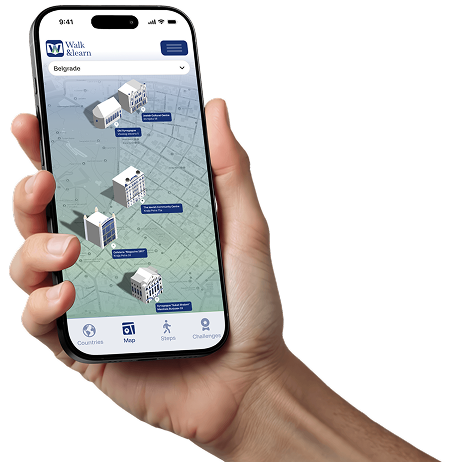
Wishing to move from Jalija to Zerek, the Jewish community collected funds to build a new synagogue as a first step. Many Jews donated large sums of money, and Mata Nahman Levi bequeathed all his movable and immovable property to the Jewish community. From this legacy, two plots were purchased—one for the Bet Israel synagogue and the other for the building of the Jewish Church-School Community.
In the presence of official delegates from the Ministry of Religion, the municipality, the city, and many Jewish cultural institutions, the foundation stone of the Jewish Church-School Community Center was consecrated on June 5, 1927. A charter bearing the signatures of prominent members of the Sephardic community was embedded in the foundations.
The building of the Jewish Church-School Community Center was constructed according to the design of architect Samuel Sumbul. Construction officially began on May 18, 1928, and was fully completed on September 27 of the same year. The building was consecrated on April 21, 1929. At that time, the president of the Sephardic community was Dr. Solomon J. Alkalaj, and the vice president was Šemaja Demajo. A loan for construction was taken from the State Mortgage Bank, while the Ministry of Forestry and Mining supported the project with a donation of timber.
The complex consisted of two buildings: the main one facing the street and a secondary one facing the courtyard toward the Bet Israel synagogue. The buildings were connected by a large ceremonial hall. In the basement of the main building, there was one apartment for the caretaker and another for rent. The ground floor of the courtyard-facing building was reserved for representative purposes and included the Union office, the rabbinate, a large meeting hall, a reading room, and the B’nai B’rith Lodge.
On the first floor, there were four classrooms for religious education. The second floor housed the boardroom, treasury, and offices for the president and secretary of the Sephardic community. The third floor was reserved for cultural, educational, and humanitarian societies, such as the Serbian-Jewish Singing Society and the Jewish Women’s Society.
The Jewish Church-School Community Center also served as a venue for secular activities; lectures were held here by mathematician Mihailo Petrović Alas, geophysicist and astronomer Milutin Milanković, biologist and physician Ivan Đaja, and others.
In 1959, the Jewish Historical Museum was opened in building no. 71a (first permanent exhibition), and a second permanent exhibition was opened in 1969 in its current space. In March 1961, the building no. 71 was nationalized.
Today, part of the building at no. 71a houses the premises of the Jewish Community of Belgrade, and it is also used by the Serbian-Jewish Singing Society “Braća Baruh.”
On the first floor are the premises of the Jewish Historical Museum and the Federation of Jewish Communities of Serbia.